Short-term or long-term?
Listed shares, equity mutual funds and other listed securities become long-term after 12 months. Everything else – property, gold, unlisted shares, debt funds bought before April 2023 – needs more than 24 months. Debt mutual funds bought on or after 1 April 2023 are always treated as short-term and taxed at your slab rate, however long you hold them. The Transactions sheet works out the holding period from the two dates and sets the term automatically.
Tax rates in 2026-27
Short-term gains on listed shares and equity funds (with STT paid) are taxed at 20%. Long-term gains on all assets are taxed at 12.5% without indexation, and the first ₹1.25 lakh of long-term gains on listed equity in a year is exempt (old section 112A). Other short-term gains are added to your income and taxed at slab rates. 4% cess applies on top; surcharge for high incomes is not included.
Grandfathering and indexation
For listed shares and equity funds bought before 1 February 2018, the cost is the higher of the actual cost and the fair market value on 31 January 2018 (capped at the sale value), so gains made before that date stay tax-free. Enter the FMV in its column and the sheet does the rest.
For land or buildings bought before 23 July 2024, resident individuals and HUFs pay the lower of 12.5% on the gain without indexation and 20% on the gain with indexation. The sheet works out both using the Cost Inflation Index – 384 for 2026-27 – and picks the cheaper option. For property bought before 1 April 2001 you can use its fair market value on that date as the cost.
Set-off of losses
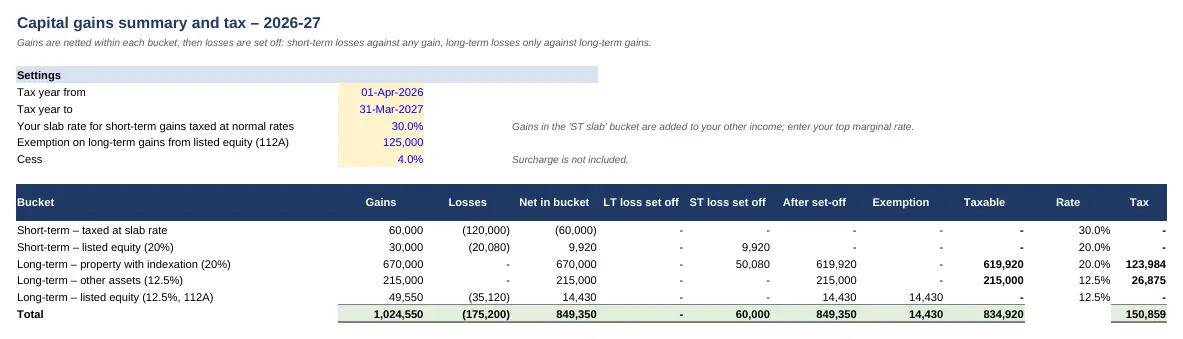
Gains and losses are first netted within each tax bucket. A short-term capital loss can then be set off against any capital gain, short or long term; a long-term loss only against long-term gains. The Summary applies short-term losses first to slab-rate gains, then 20% gains, then long-term gains – usually the order that saves most tax. Losses that remain can be carried forward for eight years if you file your return on time.
Free vs Pro
The free edition computes gains, set-off and tax for up to 200 sales. The Pro edition adds an exemption planner for reinvesting in a house or 54EC bonds, with deadlines, and a harvesting planner to use the ₹1.25 lakh exemption on listed equity each year.
Written by Prakash Bagchi, finance professional and founder of PB Lab. Last reviewed .