Excel template · Tax & compliance

Compliance Calendar 2026-27 in Excel (GST, TDS, ITR, ROC)

Every common statutory due date for an Indian business from April 2026 to May 2027 in one Excel tracker: GST returns, TDS/TCS deposits and statements under the Income-tax Act, 2025, advance tax, income-tax returns and audit reports, PF/ESI and ROC/LLP filings. Tick what applies to you, mark items done and see what is due in the next 30 days.

For: Small businesses, company secretaries, accountants, tax consultants and CA firms who track compliance dates for themselves or for clients.

Free download · no sign-up · no macros · Excel 2010+, Google Sheets, LibreOffice

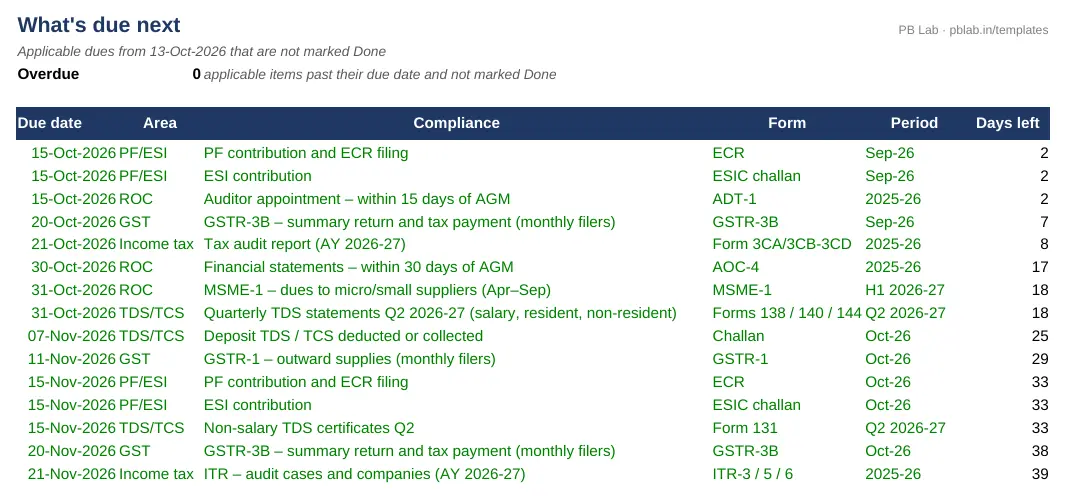
Preview of the Compliance Calendar 2026-27 Excel template with sample data
Main sheet with sample data

At a glance

What it is
Compliance Calendar 2026-27 — an Excel workbook for Indian taxpayers, businesses and tax practitioners
Free edition
4 sheets (Guide, Settings, Calendar, Due Next) — free download, no sign-up
Pro edition
6 sheets, adds Client Tracker and Late Fees & Interest — ₹19 one-time (regular ₹99)
Works in
Microsoft Excel 2010 or later, Google Sheets, LibreOffice Calc — no macros
Checked
Recalculated with zero formula errors; sample data and a Guide sheet included
Made by
Prakash Bagchi, finance professional, PB Lab (Raipur, India)

Free vs Pro: what you get

SheetFreePro
Guide
What it does, how to use it, assumptions and a live status check
Settings
Your entity name, today's date and 14 Yes/No switches – monthly or QRMP GST, TDS, TCS, advance tax, audit, PF/ESI, company, LLP and more
Calendar
About 125 dated compliances plus 40 rows for your own, with form, period, status, date done, days left, overdue highlighting and filters
Due Next
The next 30 applicable items not yet done, sorted by date, and a count of anything overdue
Client Tracker
60 clients × 12 months: GSTR-1, GSTR-3B and TDS status for each client, with pending counts – for CA firms and consultants
—
Late Fees & Interest
Late fee and interest rules for GST, TDS, ITR and ROC filings, plus calculators for late-fee days and TDS interest months
—

Pro edition

Get Compliance Calendar 2026-27 – Pro

₹19₹9981% OFF

Everything in the free edition, plus:

  • Client Tracker — 60 clients × 12 months: GSTR-1, GSTR-3B and TDS status for each client, with pending counts – for CA firms and consultants
  • Late Fees & Interest — Late fee and interest rules for GST, TDS, ITR and ROC filings, plus calculators for late-fee days and TDS interest months
  • One-time payment, instant .xlsx download, free updates
+91

Secure payment by Razorpay · UPI, cards, netbanking & wallets

We use your details only to deliver the file and support your purchase. See our privacy policy and terms.

Need more than one? The Tax & Compliance Kit has all 5 tax & compliance Pro templates, including this one, for ₹74.

How to use it

  1. 1Download the free file and read the Guide sheet.
  2. 2On Settings, enter your name and switch on the compliances that apply to you (Y/N).
  3. 3Open Calendar: items that don't apply are greyed out; filter by area or month.
  4. 4When you file or pay, set Status to Done and enter the date.
  5. 5Check Due Next every week – it lists what's coming in date order and counts overdue items.

What a compliance calendar covers

An Indian business typically has 15 to 25 statutory deadlines a month across GST, TDS, PF/ESI and, once a year, income tax and ROC. Missing one costs late fees and interest, and for TDS it can also disallow the expense. This calendar puts all the common dates for April 2026 to May 2027 in one sheet with the form, the period it relates to and a status column, so you can see at a glance what is done and what is pending.

It covers GSTR-1 and GSTR-3B for monthly filers, IFF, PMT-06 and quarterly returns for the QRMP scheme, CMP-08 and GSTR-4 for composition dealers, GSTR-9 and 9C; monthly TDS and TCS deposits; quarterly TDS statements and certificates; advance tax; income-tax returns and the tax audit report for AY 2026-27; PF and ESI; and the main company and LLP annual filings.

What changed for 2026-27: the Income-tax Act, 2025

The Income-tax Act, 2025 applies from 1 April 2026. For TDS and TCS this changes the form numbers: quarterly TDS statements are Forms 138 (salary), 140 (resident, non-salary) and 144 (non-resident), the TCS statement is Form 143, and TDS certificates are Forms 130 (salary, earlier Form 16) and 131 (non-salary, earlier 16A). The calendar shows the new form with the old name in the note column. Returns for FY 2025-26 (assessment year 2026-27), filed during 2026, are still under the 1961 Act.

Using it for one business or many clients

For one business, switch off what doesn't apply – an LLP has no AOC-4, a company not in the QRMP scheme has no IFF – and the calendar greys those rows out and leaves them out of Due Next and the overdue count. Add your own dates, such as licence renewals, insurance or loan reviews, in the 40 custom rows.

CA firms and consultants can use the Pro edition's Client Tracker, which lists up to 60 clients with their GST filing type and tracks GSTR-1, GSTR-3B and TDS status month by month, so pending work for the month is visible in one place.

Dates change – keep it current

Due dates are extended from time to time by CBDT, CBIC and the MCA, and some are linked to the date of your AGM. Every date is an input cell: overwrite it when an extension is notified, and the days-left and overdue figures update. Confirm critical dates on the official portals before filing.

Free vs Pro

The free edition has the full calendar, settings and Due Next list. The Pro edition adds the multi-client tracker and a guide to late fees and interest with small calculators for each.

Written by Prakash Bagchi, finance professional and founder of PB Lab. Last reviewed .

Frequently asked questions

What is the due date for GSTR-3B?

The 20th of the next month for monthly filers. Quarterly (QRMP) filers file by the 22nd or 24th of the month after the quarter, depending on their state, and pay monthly tax by the 25th through PMT-06.

When is TDS deposited for 2026-27?

By the 7th of the next month, and by 30 April for tax deducted in March. Quarterly TDS statements are due by 31 July, 31 October, 31 January and 31 May.

What are Forms 138, 140 and 144?

They replace Forms 24Q, 26Q and 27Q under the Income-tax Act, 2025 – quarterly TDS statements for salary, resident non-salary payments and payments to non-residents. Form 143 replaces 27EQ for TCS.

What are the advance tax due dates?

15% by 15 June, 45% by 15 September, 75% by 15 December and 100% by 15 March. Taxpayers under the presumptive scheme pay the whole amount by 15 March.

When are AOC-4 and MGT-7 due?

AOC-4 within 30 days of the AGM and MGT-7 within 60 days. If the AGM is held on 30 September, they fall due on 30 October and 29 November.

Can I add my own deadlines?

Yes. The Calendar has 40 blank rows for your own items; they appear in Due Next and the overdue count like the rest.

Will the dates be updated if they are extended?

Each date is an input you can overwrite. Pro buyers get free updates of the file when major extensions are announced.

How much does the Pro edition cost and how do I get it?

The Pro edition is ₹19 (regular price ₹99), a one-time payment through Razorpay by UPI, card, netbanking or wallet. You download the .xlsx file right after paying, and the download page works again later if you bookmark it. Pro adds: Client Tracker, Late Fees & Interest.

Related free calculators

More Excel templates

See all templates →

Disclaimer: This template is a working aid, not legal, tax or accounting advice. Sample data is fictional. Laws, rates and thresholds change — verify them against the current Act, rules and notifications, or with a qualified professional, before relying on the results. PB Lab is not responsible for decisions made using this file.