Why keep a fixed asset register
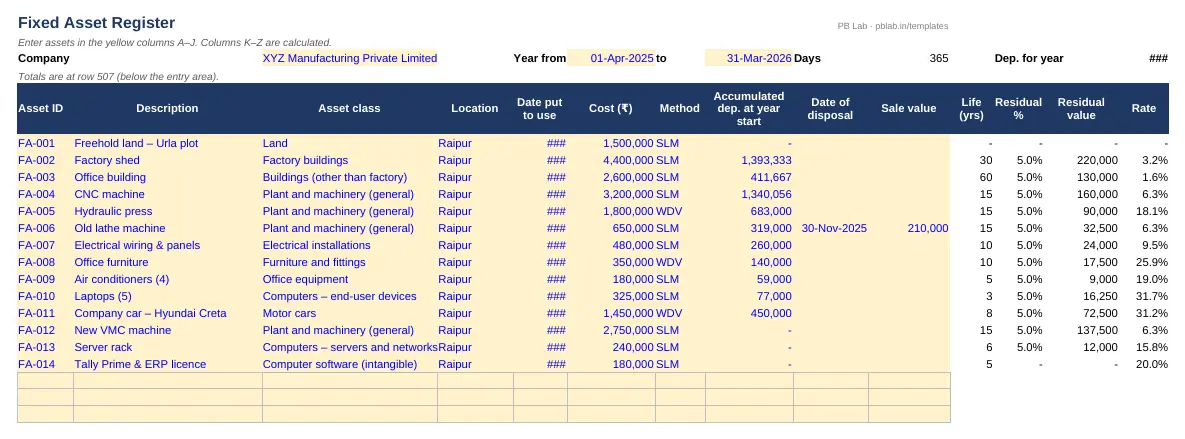
A fixed asset register is the subsidiary record behind the property, plant and equipment figure in the balance sheet. It lists each asset with its cost, date of capitalisation, location, depreciation and carrying amount. Auditors rely on it, and CARO 2020 asks the auditor to report whether the company maintains proper records of PPE showing full particulars, quantitative details and situation, and whether the assets have been physically verified at reasonable intervals.
Schedule II useful lives
Schedule II to the Companies Act, 2013 does not prescribe depreciation rates. It prescribes useful lives for classes of assets — for example, general furniture and fittings 10 years, office equipment 5 years, computers and laptops 3 years, servers and networks 6 years, motor cars (other than for hire) 8 years. The residual value of an asset is normally not more than 5% of its original cost.
A company may use a life or residual value different from Schedule II if it is supported by a technical assessment, and it must disclose the justification. The Useful Lives sheet in the template carries the common classes so you can pick them from a drop-down.
SLM or WDV
Under the straight-line method, depreciable amount (cost less residual value) is spread evenly over the useful life. Under the written-down-value method, a fixed rate is applied to the opening carrying amount each year; the rate is derived from the useful life and residual value using the formula 1 − (residual ÷ cost)^(1/life). The template calculates both and uses the method you choose per asset.
Depreciation is charged pro-rata from the date an asset is available for use, and up to the date of disposal. Once an asset reaches its residual value, depreciation stops — the register caps the charge automatically so the net block never falls below residual value.
Income-tax depreciation is different
For income-tax, depreciation is calculated on blocks of assets at prescribed rates on the written-down value of the block, not asset by asset. If an asset is acquired and put to use for less than 180 days in the year, only half of the normal rate is allowed for that year. Because the two calculations differ, companies keep a separate tax working and the difference feeds into deferred tax. The Pro edition includes that block-wise income-tax working.
Good habits for the register
Give every asset a unique ID and tag it physically. Capitalise significant components with different lives separately — the component approach is required under Schedule II. Record the location and custodian so physical verification is quick. And reconcile the register's gross block and accumulated depreciation with the general ledger every quarter, not just at year-end.
Written by Prakash Bagchi, finance professional and founder of PB Lab. Last reviewed .