What AS 3 asks for
AS 3, Cash Flow Statements, requires an entity to show how its cash and cash equivalents changed during the year, split into three activities. Operating activities are the main revenue-producing activities. Investing activities cover buying and selling long-term assets and investments. Financing activities are the changes in owners' capital and borrowings. Cash equivalents are short-term, highly liquid investments that are readily convertible into known amounts of cash — usually with a maturity of three months or less from the date of acquisition.
For a company, the cash flow statement is part of the 'financial statements' defined in section 2(40) of the Companies Act, 2013. One person companies, small companies, dormant companies and private companies that qualify as start-ups are exempt. Non-corporate entities follow ICAI's applicability criteria for their level of entity.
Indirect method, step by step
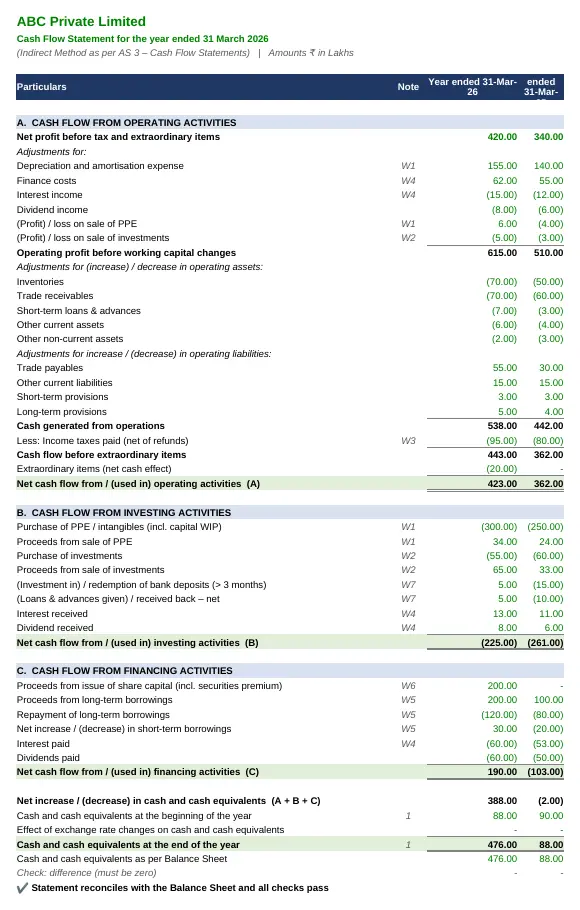
Most Indian companies use the indirect method because it is built from information you already have. You start with net profit before tax, add back non-cash items such as depreciation and amortisation, and remove items that belong to investing or financing — profit or loss on sale of assets, interest expense, interest and dividend income. That gives operating profit before working-capital changes.
Next you adjust for movements in working capital: an increase in trade receivables or inventory uses cash, while an increase in trade payables or other current liabilities releases cash. After deducting income tax paid, you reach net cash from operating activities. The template does every one of these adjustments in the Workings sheet so you can trace each figure back to the balance sheet.
Where interest, dividends and tax go
For an enterprise that is not a financial institution, AS 3 treats interest paid and dividends paid as financing cash flows, and interest and dividends received as investing cash flows. Taxes on income are shown under operating activities unless they can be specifically identified with investing or financing. Financial enterprises classify interest paid and received as operating. The template follows the non-financial-enterprise treatment.
The checks that matter
A cash flow statement is only useful if it ties out. The workbook runs seven checks — among them, every balance sheet must tally, the fixed-asset and loan roll-forwards must reconcile, and opening cash plus net cash flow must equal the closing cash on the balance sheet, for both years. If any check fails, the Guide sheet shows which one, so you can fix the input instead of forcing a balancing figure.
Free vs Pro
The free edition gives you the complete indirect-method statement under AS 3. The Pro edition adds the direct-method statement, which some lenders and group auditors ask for, and an Ind AS 7 version with the paragraph 44A disclosure — a reconciliation of opening and closing liabilities arising from financing activities, showing cash and non-cash changes separately.
Written by Prakash Bagchi, finance professional and founder of PB Lab. Last reviewed .