Excel template · Finance

Cash Flow Forecast Template in Excel (12 Months, with GST)

Enter opening cash, your customers' and suppliers' credit terms and GST rate once, then monthly sales, purchases and expenses. The workbook turns them into month-by-month cash in, cash out and closing balance, flags months below your minimum cash and tells you how much extra funding you would need.

For: Owners and accountants of small businesses and MSMEs who want to see cash shortfalls before they happen.

Free download · no sign-up · no macros · Excel 2010+, Google Sheets, LibreOffice

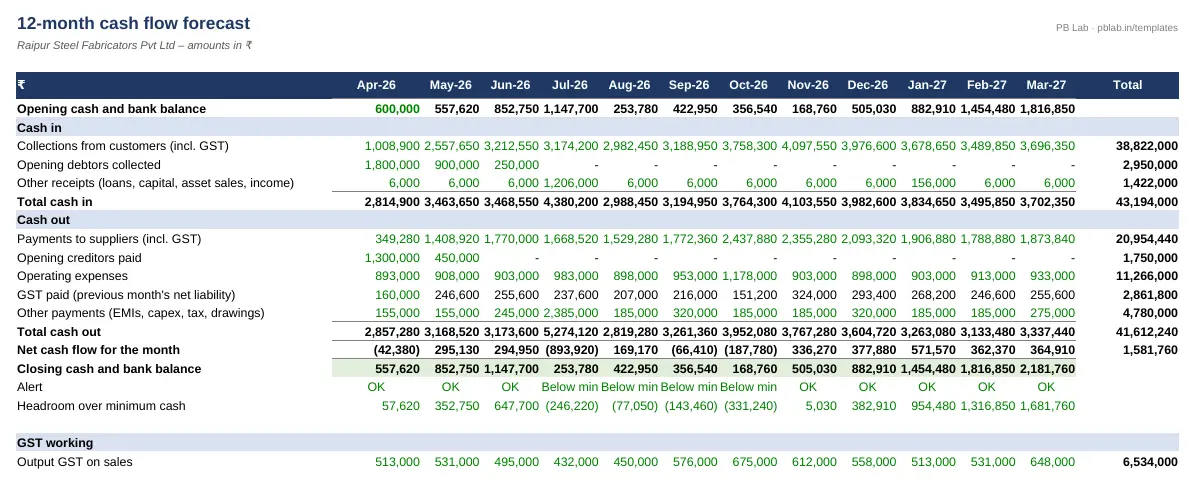
Preview of the Cash Flow Forecast (12 Months) Excel template with sample data
Main sheet with sample data

At a glance

What it is
Cash Flow Forecast (12 Months) — an Excel workbook for Indian businesses and accountants
Free edition
4 sheets (Guide, Setup, Inputs, Forecast) — free download, no sign-up
Pro edition
6 sheets, adds Scenarios and Actual vs Forecast — ₹19 one-time (regular ₹99)
Works in
Microsoft Excel 2010 or later, Google Sheets, LibreOffice Calc — no macros
Checked
Recalculated with zero formula errors; sample data and a Guide sheet included
Made by
Prakash Bagchi, finance professional, PB Lab (Raipur, India)

Free vs Pro: what you get

SheetFreePro
Guide
What it does, how to use it, assumptions and a live status check
Setup
Opening cash, minimum balance, collection and payment patterns, GST rates and opening debtors/creditors
Inputs
Monthly sales and purchases (excl. GST), up to 16 expense lines, loans, capex, EMIs, tax and drawings
Forecast
12-month cash in, cash out and closing balance with alerts, GST working, summary, checks and a chart
Scenarios
Base, downside and upside cases — change sales, costs and slow collections — with the funding gap and a chart
—
Actual vs Forecast
Enter actual cash in/out as months close; variance and a rolling outlook for the rest of the year
—

Pro edition

Get Cash Flow Forecast (12 Months) – Pro

₹19₹9981% OFF

Everything in the free edition, plus:

  • Scenarios — Base, downside and upside cases — change sales, costs and slow collections — with the funding gap and a chart
  • Actual vs Forecast — Enter actual cash in/out as months close; variance and a rolling outlook for the rest of the year
  • One-time payment, instant .xlsx download, free updates
+91

Secure payment by Razorpay · UPI, cards, netbanking & wallets

We use your details only to deliver the file and support your purchase. See our privacy policy and terms.

Need more than one? The Finance & Accounts Kit has all 14 finance Pro templates, including this one, for ₹208.

How to use it

  1. 1Download the free file and read the Guide sheet.
  2. 2On Setup, enter the first month, opening cash, the minimum balance you want to keep, your collection and payment patterns, GST rates and opening balances.
  3. 3On Inputs, enter monthly sales and purchases excluding GST, then expenses, loans, capex, EMIs, advance tax and drawings.
  4. 4Open Forecast — check the months marked 'Below min' and the extra funding figure in the summary.
  5. 5Each month, roll the forecast forward: update the first month, opening balances and the months ahead.

Why profit is not cash

A business can show a healthy profit and still be unable to pay salaries on the 1st. Customers on 30- or 60-day credit pay after you have already bought materials, paid staff and deposited last month's GST. A loan instalment, a new machine or the festive stock build-up can all land in the same month. A cash flow forecast shows those gaps months in advance, while you still have time to arrange a limit, chase collections or move a purchase.

How the template turns sales into cash

You enter sales excluding GST. The workbook adds GST at your rate and spreads the amount over four months using your collection pattern — for example 30% collected in the same month, 45% next month, 20% in the second month and 5% in the third. Purchases work the same way with your supplier payment pattern. Opening debtors and creditors are settled in the first months as you specify, so the forecast starts from your real position rather than from zero.

Everything else — salaries, rent, power, freight, EMIs, capex, advance tax, owners' drawings, loans received, asset sales — is entered as cash in the month it is paid or received.

GST is a cash item too

GST collected from customers is not your money, but it sits in your bank account until you pay it. The forecast works out output GST on sales less input tax credit on purchases each month and pays the net amount in the following month, in line with the GSTR-3B due date (the 20th for monthly filers). If credit exceeds tax in a month, it is carried forward. Modelling this matters: in a growing month the GST outflow can be larger than many expense lines.

Minimum cash and the funding gap

Set a minimum balance you never want to go below — many small businesses use one to two months of fixed costs. Every month whose closing balance falls under it is marked 'Below min'. The summary shows the lowest balance, the month it occurs, how many months are below the floor and how much extra money you would need to stay above it. That last figure is what to discuss with your bank for a cash credit or overdraft limit, or the amount to cover by speeding up collections.

Planning for the usual Indian cash crunches

Advance tax instalments fall due on 15 June, 15 September, 15 December and 15 March. Diwali brings bonuses and stock purchases a month or two before the sales come in. March often sees big supplier payments and year-end tax. Payments to micro and small suppliers should be made within the agreed period, which cannot exceed 45 days under the MSMED Act. Put these in the inputs and the forecast shows their combined effect month by month.

Free vs Pro

The free edition gives you the complete 12-month forecast with GST, alerts, summary and chart. The Pro edition adds a scenarios sheet (base, downside and upside, including the effect of customers paying a month late) and an actual-vs-forecast sheet that replaces forecast months with actuals as they close and gives you a rolling outlook for the rest of the year.

Written by Prakash Bagchi, finance professional and founder of PB Lab. Last reviewed .

Frequently asked questions

What is a cash flow forecast?

A month-by-month estimate of the cash coming into and going out of the business, and the bank balance at the end of each month. It shows shortfalls before they happen.

How is this different from the cash flow statement template?

The cash flow statement (AS 3) reports what happened last year from the balance sheet. This template looks forward and estimates the next 12 months from your plans and credit terms.

Should I enter sales including or excluding GST?

Excluding GST. The template adds GST at your rate, collects it from customers with the sale and pays the net GST to the government the following month.

How much minimum cash should a small business keep?

A common rule of thumb is one to two months of fixed costs such as salaries, rent and EMIs. Businesses with lumpy collections often keep more.

What if the forecast shows a shortfall?

Look at the month and the funding gap in the summary. Options include faster collections, longer supplier credit, delaying capex, or arranging a cash credit or overdraft limit before the month arrives.

Can I compare actual cash with the forecast?

The Pro edition has an Actual vs Forecast sheet. Enter actual cash in and out from your bank statement as each month closes to see the variance and a revised outlook.

Does it work in Google Sheets?

Yes. It uses only standard functions and has been recalculated with zero formula errors.

How much does the Pro edition cost and how do I get it?

The Pro edition is ₹19 (regular price ₹99), a one-time payment through Razorpay by UPI, card, netbanking or wallet. You download the .xlsx file right after paying, and the download page works again later if you bookmark it. Pro adds: Scenarios, Actual vs Forecast.

Related free calculators

More Excel templates

See all templates →

Disclaimer: This template is a working aid, not legal, tax or accounting advice. Sample data is fictional. Laws, rates and thresholds change — verify them against the current Act, rules and notifications, or with a qualified professional, before relying on the results. PB Lab is not responsible for decisions made using this file.