What Schedule III is
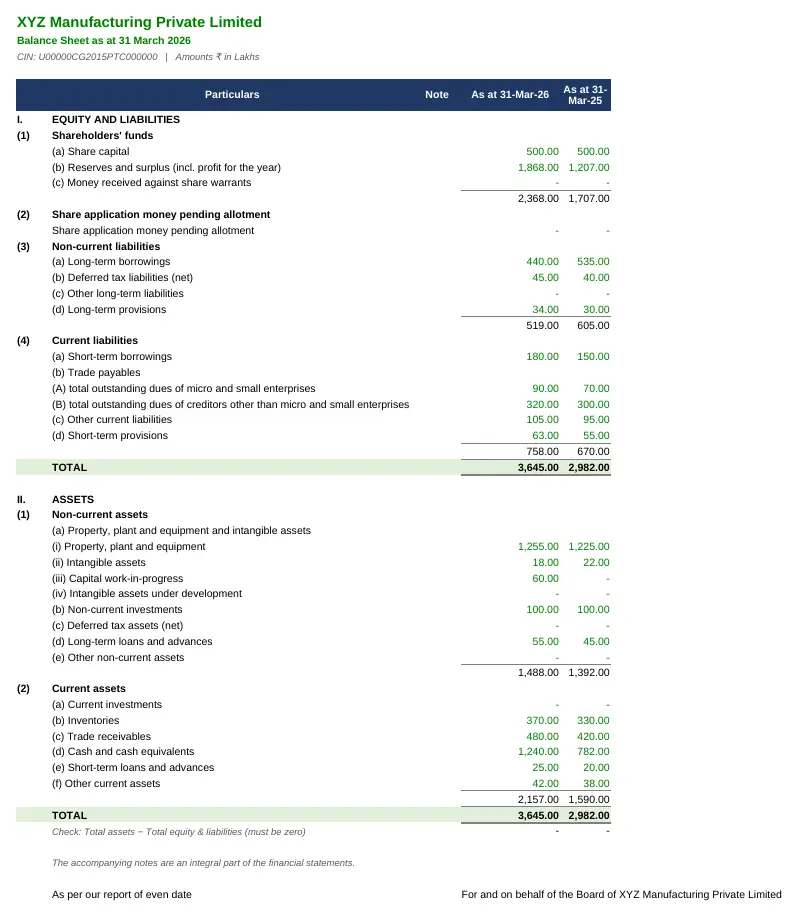
Schedule III to the Companies Act, 2013 prescribes the format of a company's balance sheet and statement of profit and loss. Division I applies to companies that follow the Companies (Accounting Standards) Rules — the old Indian GAAP. Division II applies to companies that follow Ind AS, and Division III to NBFCs that follow Ind AS. This template uses Division I, which covers most small and medium private companies.
The balance sheet is in vertical form: Equity and Liabilities first (shareholders' funds, non-current liabilities, current liabilities), then Assets (non-current and current). The statement of profit and loss lists revenue from operations, other income, expenses by nature, exceptional items, tax and earnings per share.
Current or non-current?
Every asset and liability must be classified as current or non-current. An item is current if it is expected to be realised or settled within twelve months after the reporting date, or within the company's normal operating cycle, or is held mainly for trading. Long-term borrowings that fall due within twelve months move to 'current maturities' under short-term borrowings. Each Schedule III code in the Mapping sheet already sits under the right head, so you decide once per ledger, not once per year.
What changed with the 2021 amendment
The amendment notified in March 2021, effective from 1 April 2021, added several disclosures to Division I. These include shareholding of promoters, ageing schedules for trade receivables, trade payables and capital work-in-progress, title deeds of immovable property not held in the company's name, details of benami property and wilful-defaulter status, transactions with struck-off companies, and crypto-asset dealings.
It also requires 11 ratios — current ratio, debt-equity, debt service coverage, return on equity, inventory turnover, trade receivables turnover, trade payables turnover, net capital turnover, net profit ratio, return on capital employed and return on investment — with an explanation for any ratio that changed by more than 25% compared with the previous year. The Pro edition calculates all 11 and flags the ones that need a comment.
Rounding off
Schedule III sets rounding rules by turnover. A company with turnover below ₹100 crore may round to the nearest hundreds, thousands, lakhs or millions, or decimals of these. Companies with turnover of ₹100 crore or more may round to lakhs, millions or crores, or decimals of these. Whatever unit you choose, use it consistently across the financial statements.
How the mapping approach saves time
Instead of building SUMIF formulas every year, you map each ledger once. Next year you paste the new trial balance, the existing ledgers pick up their mapping and only new ledgers need attention — the 'unmapped' counter tells you how many. Because previous-year figures come from the same mapping, comparatives stay consistent.
Written by Prakash Bagchi, finance professional and founder of PB Lab. Last reviewed .