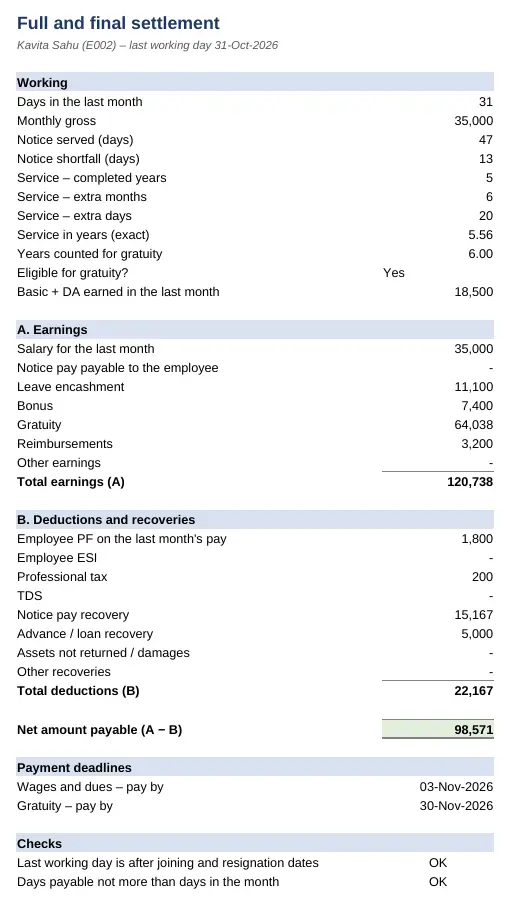
What full and final settlement covers
Full and final (F&F) settlement squares up everything between an employer and an employee who leaves. On the earnings side: salary up to the last working day, notice pay if the employer ends the employment without notice, encashment of unused earned leave, bonus, gratuity if eligible, and pending reimbursements. On the other side: PF, ESI, professional tax and TDS on the final pay, recovery for any notice period not served, outstanding advances or loans, and unreturned company property.
Two working days
Since the labour codes came into force on 21 November 2025, section 17(2) of the Code on Wages, 2019 requires the wages of an employee who is removed, dismissed, retrenched or resigns to be paid within two working days. That is much faster than the 30–45 days many companies were used to, so the settlement has to be prepared before or on the last working day. Gratuity has its own deadline of 30 days.
Notice pay and leave encashment
If an employee resigns and leaves before completing the notice period in their appointment letter, the employer may recover pay for the shortfall – usually on gross pay, sometimes on Basic, divided by 30 – unless the shortfall is waived. If the employer ends the employment without notice, notice pay is payable to the employee instead.
Unused earned leave is encashed on Basic + DA, divided by 30 or 26 according to your policy. Under the labour codes a worker can encash all accumulated leave on leaving, and leave encashment is not treated as an allowance for the 50% wage rule.
Gratuity and tax
Gratuity is payable after five years of continuous service (one year for fixed-term employees, and none on death or disablement), at 15/26 of last drawn Basic + DA for each year, where a part-year over six months counts. Gratuity and leave encashment are partly tax-exempt for private-sector employees, so work out TDS on the settlement separately and enter it in the template.
Keep the working on file
Keep the working with the employee's file. If the settlement is disputed later, a clear statement showing days paid, the leave balance used, the notice shortfall and every recovery is the best evidence that the dues were worked out fairly and paid on time.
Full and final settlement letter format
Along with the working, most companies send the employee a short letter that confirms the amount and how it was paid. Keep it factual and attach the settlement statement. A simple format:
Subject: Full and final settlement – [Employee name], Employee code [code]
Dear [Name], with reference to your resignation dated [date] and your last working day on [date], we have completed your full and final settlement. The net amount of ₹[amount] has been paid to your bank account ending [last 4 digits] on [date] (reference [UTR]). The attached statement shows the salary for [days] days, notice pay, leave encashment of [days] days, bonus, gratuity and the deductions for PF, professional tax, TDS and recoveries.
Your relieving letter and experience certificate are enclosed. Your PF exit date has been updated with EPFO, and the TDS certificate for this financial year will be issued after the year end. Please contact HR at [email] within 15 days if you have any question about the settlement.
Signed by the HR or accounts head, with the date. The Pro edition's printable F&F statement fills in the figures for this letter.
Free vs Pro
The free edition works out the full settlement with deadlines and checks. The Pro edition adds a printable F&F statement for signatures and an exit checklist that tracks asset return, access removal, payment, EPFO exit update, relieving letter and Form 130 so nothing falls through the cracks.
Written by Prakash Bagchi, finance professional and founder of PB Lab. Last reviewed .