Gratuity under the labour codes
Gratuity is now governed by the Code on Social Security, 2020, in force from 21 November 2025, which replaced the Payment of Gratuity Act, 1972. The basic scheme is unchanged: an employee who has rendered at least five years of continuous service gets 15 days' wages for every completed year of service when they leave, retire, resign or are retrenched. The five-year condition doesn't apply on death or disablement.
The big change is for fixed-term employees, who now become eligible after one year of service, on a pro-rata basis. Wages also follow the new single definition – Basic + DA, with allowances above 50% of pay added back – and the last drawn wages under that definition set the amount for the whole service period.
The formula
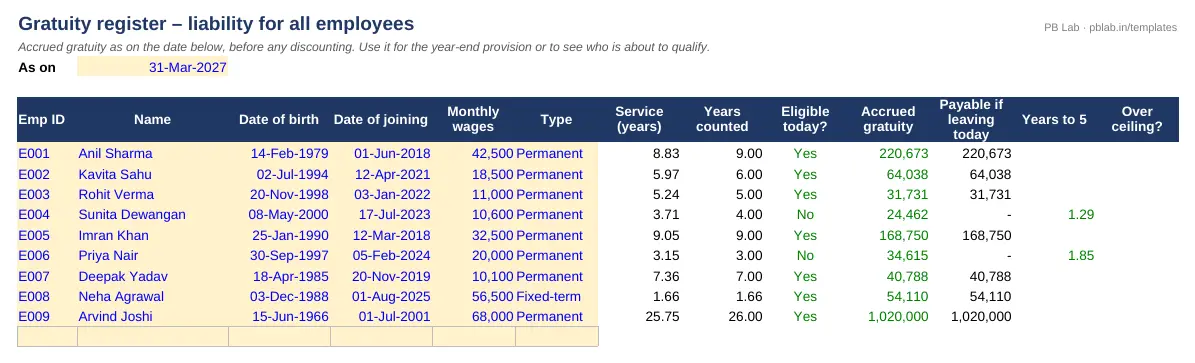
For monthly-paid employees the usual formula is last drawn monthly wages × 15 ÷ 26 × years of service. The 26 represents working days in a month, so 15/26 of a month's wages is 15 days' pay. A part-year of more than six months counts as a full year: 8 years and 7 months is counted as 9 years. The maximum gratuity is ₹20 lakh.
Example: last drawn Basic + DA of ₹32,500 and 8 years 7 months of service gives ₹32,500 × 15 ÷ 26 × 9 = ₹1,68,750.
Employers not covered by the gratuity law who pay gratuity under their own policy often use 15/30 and count only completed years. The template lets you change the days, the divisor and the minimum service if your policy differs.
Tax on gratuity
For private-sector employees, the tax-free amount is the least of the formula amount, the gratuity actually received and ₹20 lakh – a lifetime limit, so exemptions used with earlier employers reduce it. Any excess is taxed as salary. Gratuity received by government employees is fully exempt.
Gratuity as a liability
Every month of service adds to the employer's gratuity liability. The Register shows, for each employee, the gratuity accrued so far, what would be payable if they left today, and how far they are from qualifying. Companies following AS 15 or Ind AS 19 must account for gratuity on an actuarial basis; the Pro edition gives a projected-unit-credit style estimate with discount rate, salary escalation and attrition assumptions – a useful cross-check, but not a substitute for an actuary's report.
Free vs Pro
The free edition covers the calculator and the liability register. The Pro edition adds the provision estimate with the movement for the year and a printable gratuity settlement statement.
Written by Prakash Bagchi, finance professional and founder of PB Lab. Last reviewed .