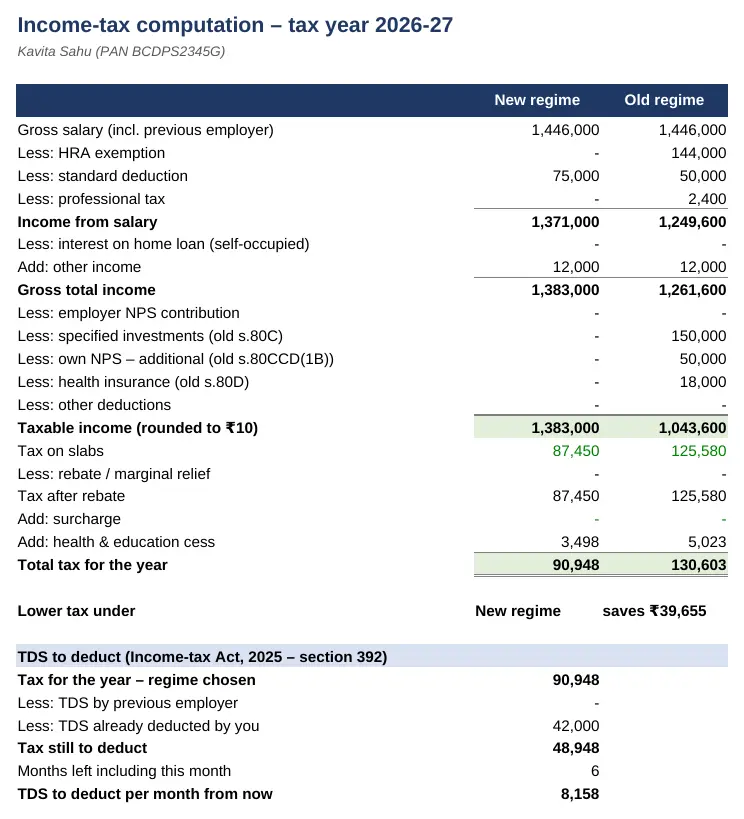
TDS on salary from 1 April 2026
The Income-tax Act, 2025 replaced the 1961 Act from 1 April 2026 and introduced the 'tax year' in place of previous year and assessment year. Salary TDS is now under section 392. The employer estimates the employee's tax for the whole year and deducts it evenly from the salary, adjusting each month as pay or declarations change. Investment declarations are made in Form 124 (earlier Form 12BB), perquisites are reported in Form 123 (earlier 12BA), the annual certificate is Form 130 (earlier Form 16) and the quarterly statement is Form 138 (earlier 24Q).
New regime for 2026-27
The new regime is the default. Income up to ₹4 lakh is tax-free; the rates then rise in ₹4 lakh steps – 5%, 10%, 15%, 20% and 25% – to 30% above ₹24 lakh. The standard deduction is ₹75,000, and the rebate makes income up to ₹12 lakh tax-free, with marginal relief so tax just above ₹12 lakh cannot exceed the income above that level. Most deductions are not available, but the employer's NPS contribution is deductible up to 14% of Basic + DA.
Old regime
In the old regime the basic exemption is ₹2.5 lakh (₹3 lakh for those aged 60–79 and ₹5 lakh from 80), with rates of 5%, 20% and 30%; the rebate covers income up to ₹5 lakh. It allows the standard deduction of ₹50,000, professional tax, HRA exemption, home-loan interest on a self-occupied house up to ₹2 lakh, and deductions such as specified investments up to ₹1.5 lakh (old section 80C), an extra ₹50,000 for own NPS contributions and health insurance premiums.
HRA exemption is the least of HRA received, rent paid minus 10% of Basic, and 50% of Basic in a metro (40% elsewhere). The Income-tax Rules, 2026 list eight metros: Delhi, Mumbai, Kolkata, Chennai, Bengaluru, Hyderabad, Pune and Ahmedabad.
Which regime is better?
It depends on deductions. Someone with modest investments and no rent or home loan usually pays less under the new regime; someone claiming HRA, the full ₹1.5 lakh of investments, NPS and a home loan may still do better in the old regime. The calculator shows both side by side with the saving, but the choice is the employee's to declare.
Monthly TDS
The TDS section takes the tax for the regime chosen, subtracts any TDS by a previous employer and what you have already deducted, and spreads the balance over the months left to March. Deposit it by the 7th of the following month, and by 30 April for March. Surcharge (on income above ₹50 lakh) is calculated, but marginal relief on surcharge is not – check those cases manually.
Written by Prakash Bagchi, finance professional and founder of PB Lab. Last reviewed .