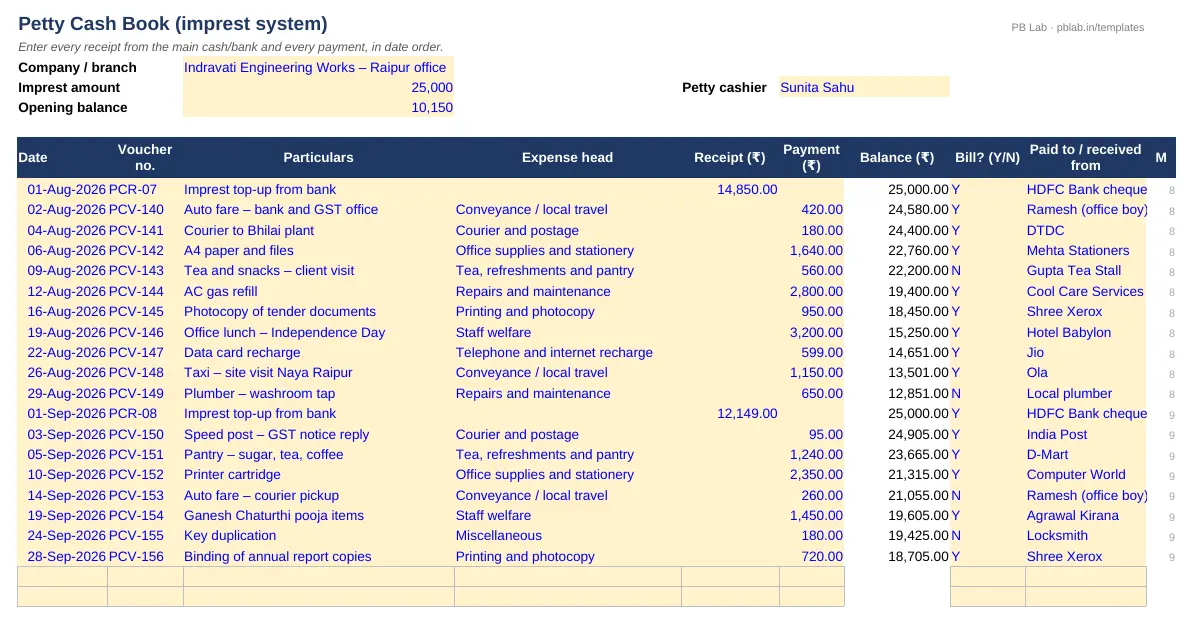
The imprest system
Under the imprest system, the petty cashier starts each period with a fixed float — say ₹25,000. Small payments are made from it against vouchers. At the end of the period, the cashier presents the vouchers and is reimbursed exactly the amount spent, bringing the cash back to the imprest amount. The beauty of the system is the built-in check: at any moment, cash in hand plus vouchers paid should equal the imprest.
What to record
Each entry needs a date, a voucher number, who was paid, what for, the expense head and the amount. Mark whether a bill or receipt is attached. Payments without a bill are highlighted, so they can be approved or supported by a self-declaration within your policy limit. Keeping entries in date order gives you a reliable running balance to compare with the cash in the box.
Monthly summary for posting
Instead of posting every small payment to the ledger, most businesses post one journal per month per expense head from the petty cash book. The Monthly Summary gives you exactly that — head-wise totals by month — along with checks for payments without a head, a negative balance or a mismatch between the book and the summary.
Cash limits to keep in mind
Petty cash is for small expenses. Income-tax law disallows a business expense paid in cash above ₹10,000 to one person in a day (section 40A(3) under the 1961 Act, with a similar rule in the 2025 Act; ₹35,000 for payments to transporters). Larger payments should go through the bank. Your own policy will usually set a much lower per-payment limit for petty cash.
GST on petty cash bills
Small purchases often come with a GST invoice — stationery, courier, repairs. If your business is registered and the supplier's invoice shows your GSTIN, the input tax credit can be claimed like any other purchase. The petty cash book records the amount paid; pass those few invoices to whoever books purchases so the GST is split out and the credit isn't lost. Bills without your GSTIN, or from unregistered suppliers, are simply expensed at full value. Food and beverages, and some other items, are blocked credits under section 17(5) of the CGST Act whatever the invoice says.
Controls that prevent problems
Count the cash regularly — ideally by someone other than the cashier — and record the count by denomination. Keep the float small enough that it needs topping up every few weeks. Number vouchers in sequence and never pay against a photocopy. The Pro edition adds a replenishment voucher with a denomination-wise cash count, plus employee expense and travel claim forms that feed the petty cash book.
Written by Prakash Bagchi, finance professional and founder of PB Lab. Last reviewed .